AIFF finds its footing at 25
After pandemic setbacks, volunteers and leadership drive a smooth, well-attended festival
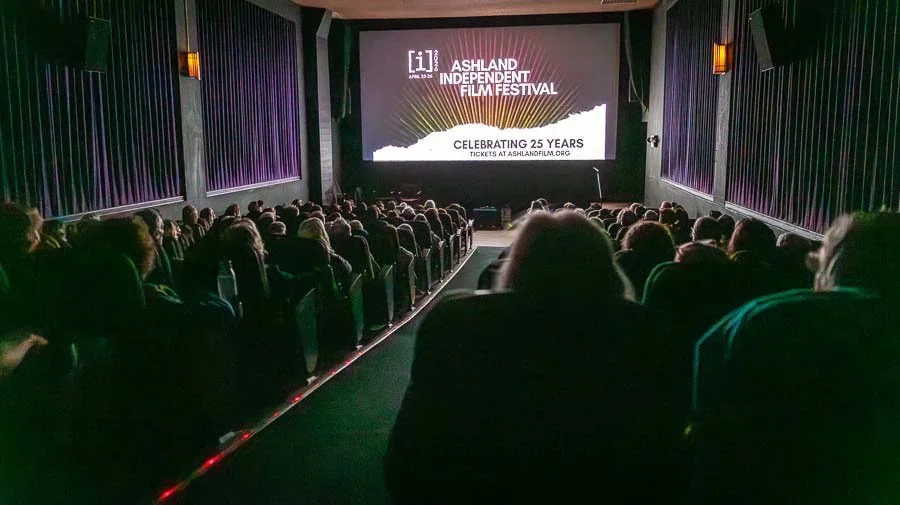
The Ashland Independent Film Festival, which began in 2001, is hosting more than 40 events in four venues in downtown Ashland through Sunday. Ashland.news photo by Bob Palermin
By Lucie K. Scheuer | Ashland.news
April 27th, 2026
If I didn’t know better, I’d say there was something big going on in town last week.
There was! It was the Ashland Independent Film Festival (AIFF), back with momentum after several difficult years following the pandemic. The Varsity Theatre was almost filled to capacity for four days. Several of the filmmakers were in town. The subjects ranged from an intimate view of Pulitzer Prize-winning poet Mary Oliver, “Mary Oliver: Saved by the Beauty of the World,” to shorts like “Eye of the Beholder,” four stories about how we perceive reality.
Really? It sounds like it was a real celebration of several filmed art forms. Tell me more.
It was AIFF’s 25th anniversary. There were 40 films in several categories being screened: shorts, feature films, silent films and film archivists, some of them featuring the stories of Rogue Valley residents like Hideko Tamura Snider, who survived the Hiroshima bombing and inspired hundreds of people in communities across Oregon to plant peace trees. There was also “The Big Cheese,” which features Sam Rollins, son of the owners of the former New Sammy’s Cowboy Bistro (lost in the Almeda Fire), and his incredible dive into the world of cheese mongering.
Wow! That was a lot of films in four days. This festival relies heavily on volunteers and staff.
It was, and this year the coordination was exceptional, especially getting ticket holders checked in and out of the Varsity in a timely manner.
The 2026 Ashland Independent Film Festival opened Thursday at the Varsity Theatre in downtown Ashland. Ashland.news photo by Bob Palermini
‘The festival is the best it’s ever been’
Did you get a chance to talk to any of the volunteer staff?
Two festival staffers were taking a break over at Dangerous Lee’s Local 31 Pub. Wendy Conner said, “I credit a lot of the resurgence of the festival to Aura Johnson, (AIFF director of programming) and Nicole Gullixson,” (managing director).
In fact, Connor said, they are “the backbone” behind its renewed success. Joanie Keller-Hand, who has been with AIFF for more than two decades, added, “The festival is the best it’s been since COVID. People are super excited.” Kathy Carter, who was also at the pub, is the festival’s volunteer coordinator and graphic designer.
That’s true, there was an energy to this event that you could really sense.
Which films did you see?
‘The Man Without a World’
Well, on Thursday evening, April 23, there was a screening of “The Man Without a World,” a silent film by Eleanor Antin created in the style of some of the Russian silent films of the early 20th century but actually made in 1991. The attention to detail, lighting, and the reproduction of tableau and fixed-shot camerawork are remarkable.
A large contingent of the Ashland Jewish community was in attendance. They showed great appreciation for the film’s composers, Alicia Svigals (founder of the Grammy-winning Klezmatics), and Donald Sosin, one of the world’s top silent film musicians. Both played the soundtrack live for 98 minutes, Svigals on violin and Sosin on piano, without skipping a beat. The music, reminiscent of Yiddish folk tunes, is often melancholic, joyful, and poignant, and it marries well with the story.
The film opens with a tribute to a fictitious Russian director, Antinov, who is supposed to have made the film in 1928. It has been rescued from “the moldy oblivion of state cellars and dusty graves of Soviet libraries, thanks to Glasnost.”
The Varsity Theatre was at near capacity with filmgoers during the 25th Ashland Independent Film Festival. Ashland.news photo by Steve Mitchell
Zevi (Pier Morton), a Yiddish poet and rogue, falls for Rukheleh (Christine Berry), the lovely daughter of a merchant. Although a gypsy-woman (Eleanor Antin) is trying to steal him away, Zevi wants to marry Rukheleh after getting her pregnant, but her parents have arranged her marriage to an older man. Conflict arises. Meanwhile, Zevi’s traumatized and sexually abused sister, Sooreleh (Ann Henrique), could meet an untimely end, as the rabbis gather to exorcise the dybbuk (evil spirit) they believe she is possessed by.
It delves into the world of the Eastern European Jewish ghetto (shtetl) at the turn of the 20th century. It shows a rather simplistic view of daily life, poverty and abuse Jews had to endure while poking fun at the movements toward Jewish socialism and intellectualism.
Revered historian Antony Polonsky says in an interview with the Yivo Institute, “We have a very romanticized view of this past, the idea that when the Jews were living in the shtetl, they lived harmoniously with one another. They all believed in the God of Abraham … and everyone lived happily in a religious cultural community,” is not accurate. Antin’s film delves into all of that, sometimes disturbingly.
As good as it is, this writer found it worrisome that audiences who don’t understand Jewish Eastern European culture might actually interpret their circumstances in the stereotypical light others have used to ostracize them.
‘The Big Cheese’
On Friday, the Varsity screened “The Big Cheese,” directed by Sara Joe Wolansky. It is an entertaining, educational, humorously robust documentary about Adam Moskowitz, a celebrity cheesemonger and coach, preparing a team of cheese mongers for the ultimate cheese competition, the Mondial du Fromage, in France.
Moviegoers find their seats Sunday, April 26, in the Varsity Theater during the 25th Ashland Independent Film Festival. Ashland.news photo by Steve Mitchell
The story focuses on Courtney Johnson from Washington state, whose humble approach to competition is endearing but threatens to tank her. She admits that, at times, she feels unnerved by an “imposter syndrome.” It’s OK. We’re rootin’ for her.
And of course, there’s Sam Rollins, overconfident in some areas and on a steep learning curve in others. Whether he can find a balance and win through is key to the story.
We get to hear about Moskowitz’s triumph over addiction and the line delivered by his son that sets him on the road to recovery. Like the cheese, the film is pleasantly sharp, earthy, with a degree of depth and worth savoring.
Debbie and Darin Peterson from Concord, California, first-timers at the festival, in the adjoining seats, agreed it’s an entertaining film with some suspenseful moments.
‘Dead Souls’
Saturday afternoon in the Varsity’s theatre three was the allegorical Western “Dead Souls,” with filmmaker Alex Cox (“Repo Man”) in attendance. Cox says he loves Westerns and shooting in the desert. It provides a place “to go and sort things out.” He says in this case, he had three weeks in Arizona and two in Spain to do that.
His film is based on a story published in 1842 by the Russian writer Nikolai Gogol, also titled “The Overcoat,” which tells the tale of Pavel Ivanovich Chichikov, a conniving and strange character who embarks on a journey through the Russian countryside to collect souls.
Cox and Gianni Garko have essentially adapted this antihero’s story as a Western, which Cox directs and stars in. Dropping in a little Peckinpah and Tarantino from time to time, Cox’s mysterious stranger is named Strindler. He travels throughout the West posing as a government official and preacher who is trying to cash in on the death of Mexican laborers.
The film also stars Zander Schloss, Merritt Crocker and Maria Robles.
There’s humor when a young pioneer woman whose lover has been shot sings, “Gladly the Cross I’d Bear,” (pun intended, one thinks). There’s seriousness when Strindler sets crosses on fire that mark the graves of Mexicans who died laboring in the mines.
Beautifully shot by Chance Falkner and Ignacio Aguilar, it is at times as silly as Lennon and McCartney’s song “Rocky Racoon,” and as somber as Sergio Leone’s “Once Upon a Time in the West.” What it really speaks to is the heinous treatment and exploitation of Mexican and Chinese laborers in the U.S., how immigrants have been treated as commodities and how it all correlates to today.
So, how do you think the festival went compared to last year?
Joe Charter, AIFF Board member, was present at the awards ceremony Saturday night at Resistance Wine Co. “I’m really proud of the way the festival has come together this year,” he said with a relieved smile. “It is financially stable and appropriately staffed.”
A great jumping-off place for next year.
Ashland resident Lucie K. Scheuer is a former copy editor and staff writer with the Los Angeles Times, where her work included features, reviews and a column on films in production. Email her at LucieScheuer19@gmail.com.
April 28, 2026: This article has been updated to reflect the correct spellings of Joanie Keller-Hand and Wendy Conner, and that Kathy Carter is the festival’s graphic designer and volunteer coordinator.