25 years and counting: Ashland Independent Film Festival marks a milestone and a comeback
The Southern Oregon indie festival celebrates a quarter-century of creative programming with a broadly diverse and high-quality array of filmmakers and films.
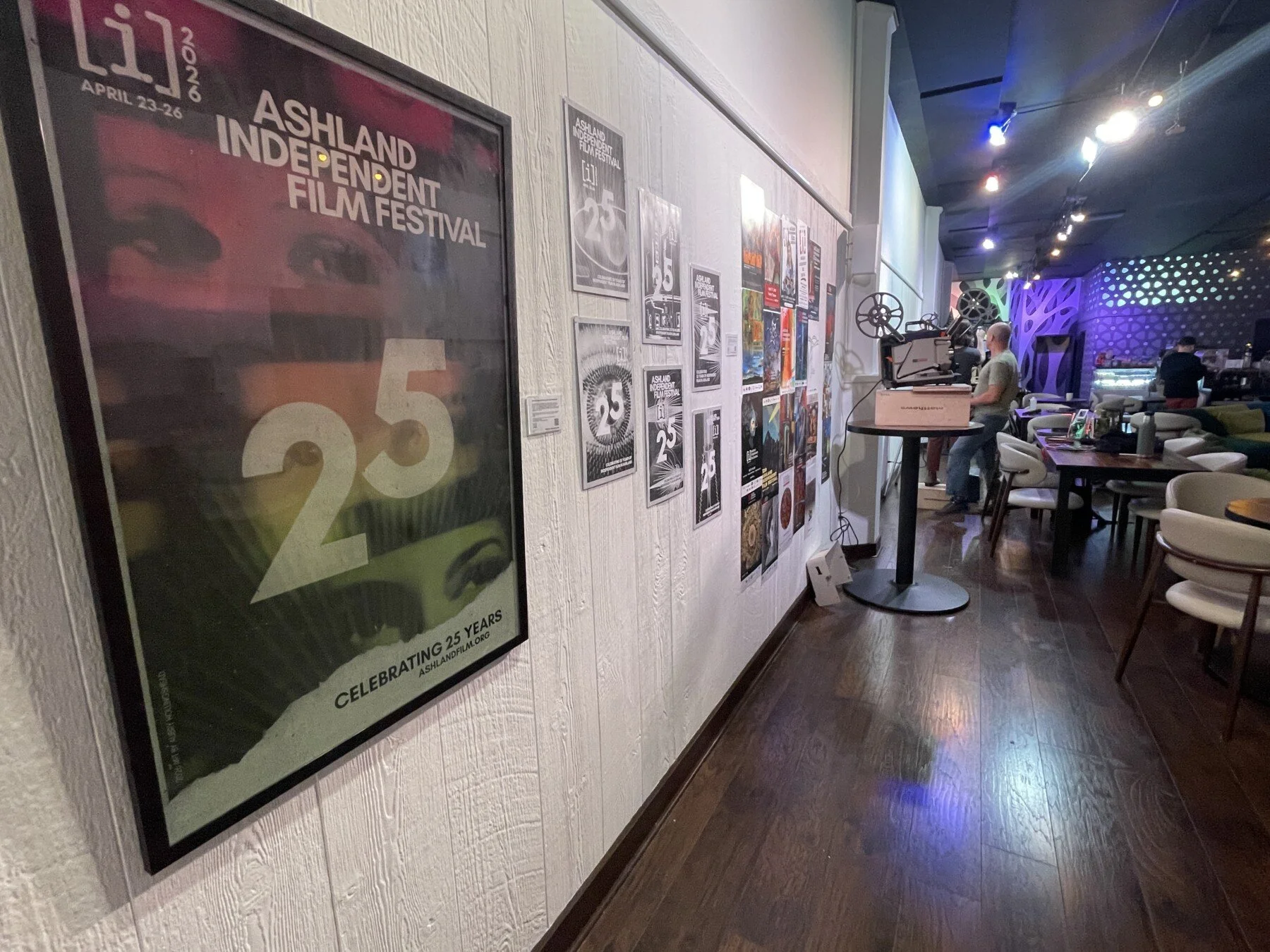
Ashland’s White Rabbit workspace hosted screenings during the 2026 Ashland Independent Film Festival (credit: AIFF)
By Marc Mohan | OREGON ARTSWATCH
May 10, 2026
ASHLAND — The Ashland Independent Film Festival celebrated its 25th anniversary late last month, a nice round number to celebrate and a good excuse to take stock of the way the event has rebounded from tumultuous times. Those tumults, as were so many endured by film fests and other arts organizations, derived largely (but not entirely) from the coronavirus pandemic and associated lockdowns, and AIFF’s future was, at times, seriously in doubt.
If history can be divided into B.C. (Before COVID) and A.C. (After COVID), the vibe in Ashland over the weekend of April 24th was that maybe we’ve finally entered the latter. Even if that feeling was illusory or naïve, it felt good. It would be nice to write a story someday about a film festival that doesn’t once mention a pandemic.
As usual, the majority of the screenings took place at the Varsity Theatre, and by the time I arrived in town on Thursday, April 23rd, the schedule grid posted in the window of festival headquarters was already thick with Sharpie lines indicating sold-out shows. Rush lines for unclaimed tickets were commonplace (and not unpleasant to be in, considering the sunny spring weather that predominated).
Other venues included the nearby creative workspace White Rabbit and artist John Pugh’s Big Dog Studio, each of them no more than a 15-minute walk from the other. With a main program including 22 features (fourteen documentaries and eight narratives), dozens of short films, and several specially curated sidebars, there were usually a few worthwhile alternatives if one’s first choice didn’t pan out.
The crowds were out at Ashland’s Varsity Theatre for the 2026 Ashland Independent Film Festival (credit: AIFF)
And the festival’s special guests and honorees, including a trove (that must be the correct collective noun) of archivists, embodied what Director of Programming Aura Johnson called the “moxie and boldness to do things their own way,” from indie-film stalwarts Cheryl Dunye and Alex Cox to re-imaginers of the documentary form such as Sam Green and the duo Soda Jerk. Southern Oregon’s own film industry was well-represented, and Harrod Blank drove up from California to share some new old footage shot by his dad Les.
Several of the features were making stops on what’s becoming a Pacific Northwest film festival circuit, including the surreal, touching documentary Joybubbles, about the fascinating blind guy who learned how to make free long-distance calls by whistling and birthed the “phone freak” movement.
Vancouver, Washington’s Beth Harrington was in town with her latest film, Our Mr. Matsura, and Green screened his new one, The Oldest Person in the World, having driven down following a Portland screening. If I Go Will They Miss Me, which took home the Best Narrative Feature at this year’s Portland Panorama film festival, and Trash Baby, which garnered the same recognition last year, both made an appearance.
While festivals always like to host premieres, it speaks to the vitality of small- to mid-sized annual festivals from Ashland to Bend to La Grande to Boise to Portland and beyond that these films get the exposure to multiple audiences they deserve in multiple locales.
Among the other feature docs, the opening night crowd-pleaser The Big Cheese, a doc about the “Olympics of cheese,” provided the rasion d’etre for a fantastic spread at the festival’s opening night gala.
Less appetizing and more enraging, but utterly vital, was First They Came for My School, a chronicle of the takeover of Florida’s New College by the anti-“woke” forces of Governor Ron DeSantis and their attempted transformation of it from a bastion of liberal arts education to a jock-centered bro factory. The blatancy of DeSantis’ chosen stooges, led by far-right propagandist Christopher Rufo, appointed to the school’s board, as they steamroll their illiberal agenda over the hearts and minds of New College’s students, faculty, and alumni, will have you seething. But the response, especially that of the students, does provide more than a glimmer of hope.
A more inspirational dynamic is on display in Blood and Guts, an unexpectedly moving portrait of the Adams family, a quartet who’ve been making microbudget horror movies in their tiny upstate New York town for years.
A quiet but powerful drama that seems destined to get less attention than it deserves, Other Houses was a highlight of the narrative slate. Katerina Stoykova (who co-wrote the screenplay and helped produce the film) stars as Radka, a Bulgarian woman who teaches poetry at the University of Kentucky. Dissatisfied with her life in the U.S., Radka decides to sell her house and move back home, a process that gets more complicated when she starts a tentative romance with one of her would-be buyers.
Playing a character loosely based on herself, Stoykova evokes a subtle melancholy, but one not without wit, and the film’s black-and-white cinematography nicely captures a sense of impending nostalgia. Stoykova was in Ashland and did a post-film Q&A, as was the director of First They Came for My College, Patrick Bresnan.
Another visitor, Alex Cox, was there to screen his latest effort, a loose and surreal adaptation of Nikolai Gogol’s 1842 “prose poem” Dead Souls, set, at least initially, in the Old West. Cox, who hasn’t lost a shred of the iconoclasm he brought to Repo Man, Sid and Nancy, and other classics, stars as a mysterious figure who arrives in a dusty Arizona town seeking the names of any Mexican workers who’ve died recently. What starts off as a macabre fable morphs into something entirely weirder by the time the credits roll. Cox, who’s presented previous films at AIFF, calls is “a doupleplus good festival” and “an example of what an independent film festival should be.”
Panelists at the ‘Raiding the Archive’ Talkback: (l to r) Richard Herskowitz, Todd Rosenblatt, Stacey Steers, Dan Angeloro, Rankin Renwick, and Rick Prelinger (credit: AIFF)
If all that plus the well-curated shorts programs (two each for narratives and docs) weren’t enough, the festival also boasts special programs put together by Richard Herskovitz, a former AIFF head programmer who has continued to contribute his curatorial talents.
This year, he shone a spotlight on the often unsung exploits of those who preserve the legacy of film in all its analog diversity and repurpose cinema’s past to serve the present. These so-called “Raiders of the Archives” take what would often be considered detritus — educational films, silent film snippets, home movies, B-pictures, and the like — and splice and dice it into, quite often, insightful commentaries on politics, culture, or psychology.
They include Rick Prelinger, whose eponymous archive has been an invaluable source of raw material for collagists and researchers for decades; Craig Baldwin, who alchemized a dizzying array of found footage into subversive alternate histories; and the Australian sisters who go by Soda Jerk.
They also included the late Dennis Nyback, whose namesake archive in Portland is working to preserve his vast collection of film. “It was especially gratifying,” Herskovitz noted, how much “the archival filmmakers loved seeing each other’s work and hanging out together. AIFF keeps making it hard for me to stay away, which is why I’ve come back to program four times since my so-called retirement.”
The highlight of this programming was a panel discussion moderated by Herskovitz and featuring Prelinger, Dan Angeloro of Soda Jerk, therapist-turned-filmmaker Jay Rosenblatt, Rankin Renwick of the Oregon Department of Kick Ass, and Stacey Steers, who painstakingly combines clips from Lilian Gish movies and Victorian illustrations into surreal new contexts. (Baldwin, sadly, was unable to attend for health reasons.)
The variety of approaches and intents, and the communitarian spirit among the group, made for fascinating discussion, as did the potential legal issues that could arise. Soda Jerk’s Hello Dankness, which screened at AIFF, for instance, stitches and tweaks hundreds if not thousands of clips from Hollywood films into a nightmarish retelling of the 2016 American presidential election and its aftermath. It’s a work of genius.
Rosenblatt introduced a selection of his short films, including the Oscar-nominated When We Were Bullies, and Jeremy Rourke, a Baldwin associate, presented his unique combination of live music and handmade cinema, while Steers and Renwick had short films that were included in a program I wasn’t able to catch.
The use of cultural products as raw material for new expression can seem all-too-common today thanks to the ease with which mash-ups and fan edits can be made and distributed, but these folks have been doing that work for far longer, and in far more interesting ways, than 99.9% of TikTokers.
One of the first, and most maniacal, such efforts was something called The Movie Orgy, which was created by director Joe Dante of Gremlins fame when he was an undergraduate in 1968. Although some versions of this Frankenstein monster created from the corpses of TV commercials, movie trailers, and (mostly) forgettable films reportedly ran up to seven hours, AIFF screened the merely five-hour cut that’s been released on Blu-ray. As it flickered on the screen at the White Rabbit over the course of a Saturday night, viewers wandered in, fell down its hole, and wandered out, their perspective on postwar American pop culture forever changed, even if they didn’t realize it.
Film festivals like AIFF are in the business of showcasing emerging talents and new voices, but they also serve as a way to recognize those, including the archivists, who labor in the trenches but are too often denied the full resources they need to do their work.
Another special guest, director Cheryl Dunye, broke through with the 1996 feature The Watermelon Woman, in which she also starred as a young Black lesbian working in a video store while she researches the life of a fictional Black actress known for playing stereotypical roles in 1930s films. The metafictional aspect of a Black woman making a film about the erasure of other Black women rings even truer today: Like so many people of color, women, and LBGTQ filmmakers who found initial success in the 1990s, Dunye hasn’t had the same opportunities to follow up her success as, say, the various Quentin Tarantino imitators.
That’s changed in recent years, to some degree, as Dunye related in a discussion accompanying a screening of her early short films, thanks to steady work in episodic television (Bridgerton, Hunting Wives, and more). The Watermelon Woman has been canonized into the Criterion Collection. Her new film, she reports, is a sci-fi remake of Sunset Blvd. starring Laverne Cox as the Norma Desmond analogue … and the AI companion she has created in her own image.
AIFF Director of Programming Aura Johnson and Pride Award recipient Cheryl Dunye during a Q & A following a screening of The Watermelon Woman (credit: AIFF)
The festival officially commemorated its quarter-century of existence with an award ceremony at Ashland’s Resistance Winery. Accepting her Pride Award, Dunye spoke about the importance of promoting “work by people that look like me, that feel like me, and also by those that want to be allies. It’s not just about being Black and queer, it’s about humanity, it’s about promoting images and making narratives that are about all of us.”
For his role in creating what Herskovitz called “an extraordinary record of 20th-century American life, as seen not through Hollywood’s lens but through the everyday media that shaped how Americans learn, work, consume, and understand their world,” and making vast portions of it available for free use, Prelinger was handed the Indie Institution Award. He spoke about the importance of preserving and circulating knowledge about the past. “History should be infrastructure. History should be like the air we breathe and the water we drink,” he exhorted. “Please support your local, regional, national, and intergalactic archivists, and put pressure on the people who fund them to make their material accessible.”
Director (and Ashland native) Jacy Mairs accepted the Best Narrative Feature Award for Trash Baby, while the intimate Adam’s Apple, shot over a twenty-year span by the mother of a trans teenager, took home the Best Feature Documentary prize. One thing each awardee could agree on was that the trophy is heavier than it looks.
In the festival headquarters, a display of the posters from each of the past editions plus this one filled much of one wall, arrayed in three rows of eight. If that math seems off, it is. There was no full festival in 2023, a stark reminder of the precarious position things were in only three years ago. But, in the same way the missing poster isn’t obvious until you look for it, you’d hardly know it from the revitalized version on display this year.
“This festival is better than ever,” says Harrington, after visiting for the first time in many years. She praised “one of the most intellectually sophisticated audiences anywhere. People engaged intensely in the Q &A sessions, and I was stopped many times over a few days by people who had more to say about my film! It was sort of stunning. But that’s the culture of Ashland and the culture of AIFF.”
Marc Mohan moved to Portland from Wisconsin in 1991, and has been exploring and contributing to the city’s film culture almost ever since, as the manager of the landmark independent video store Trilogy, the owner of Portland’s first DVD-only rental spot, Video Vérité; and as a freelance film critic for The Oregonian for nearly twenty years. Once it became apparent that “newspaper film critic” was no longer a sustainable career option, he pursued a new path, enrolling in the Northwestern School of Law at Lewis & Clark College in the fall of 2017 and graduating cum laude in 2020 with a specialization in Intellectual Property. He now splits his time between his practice with Nine Muses Law and his continuing efforts to spread the word about great (and not-so-great) movies, which include a weekly column at Oregon ArtsWatch.